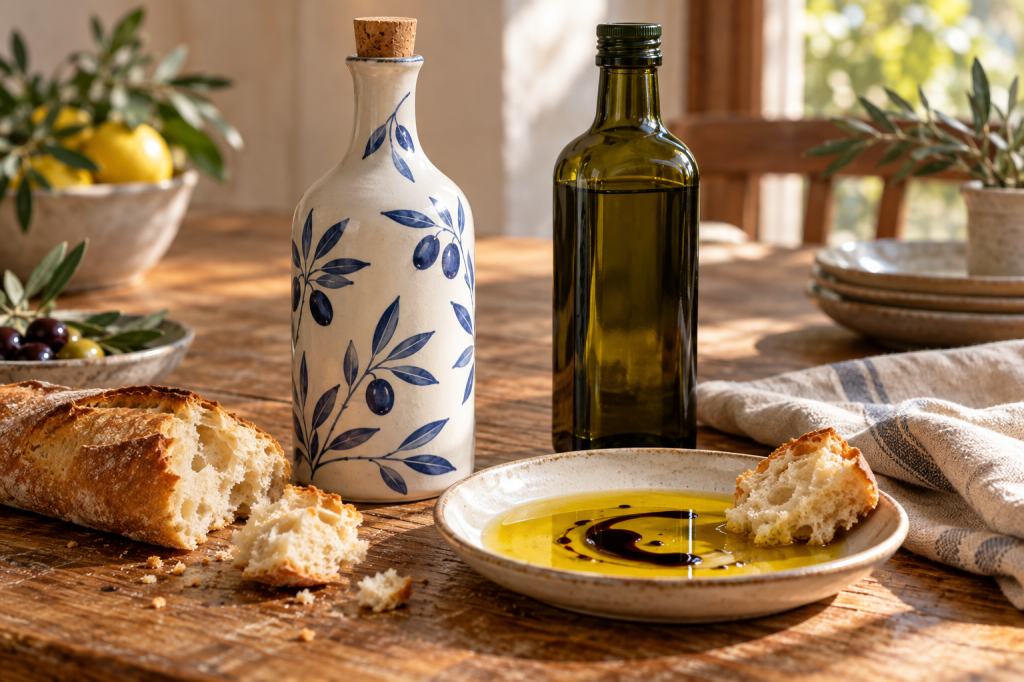
The bottle looks as though it already belongs in your kitchen.
There are painted fish on white ceramic, or a little glass handle above a basket woven around the base. Beside the ordinary bottles, this one seems to offer something extra: a slower dinner, better bread, perhaps a table worth lingering at.
Then you turn it around.
Small print. A date. An importer’s address. A row of countries abbreviated beside a lot number.
The front has given you a feeling. The back asks you to make a decision.
There is nothing wrong with enjoying a beautiful bottle. Food comes into our homes through our eyes as well as our mouths. But when the plan is to pour olive oil onto a plate and dip bread into it, a useful question interrupts the romance: would you still choose this oil if it came in a plain container?
That question does not require becoming an olive-oil expert. It simply gives the contents a chance to compete with the packaging.
Start with what you can actually learn. Who produced or distributed it? Where did the oil come from? Is there a harvest date, a best-before date, or both? A long-dated bottle offers information, but not a complete account of its freshness. UC Davis notes that a best-by date may be calculated from bottling rather than from when the olives were processed.[1]
A list of several countries is not automatically a reason to put the bottle back. The North American Olive Oil Association explains that oils may be blended to achieve a particular flavor profile.[2] An unfamiliar label deserves a closer look, not an instant verdict.
Then consider the job waiting at home.
For bread dipping, the oil will be part of nearly every bite. Before adding balsamic vinegar, try a little by itself. Smell it. Taste it on a plain piece of bread. Fresh extra virgin olive oil can have fruity aromas, bitterness, and a peppery sensation; mildness is not the only possible expression of quality.[1]
You may prefer something gentle. You may enjoy an oil that makes itself known. Either preference is more useful than buying a flavor you think you ought to admire.
Only then add the balsamic, a little at a time. Leave yourself room to notice what each ingredient contributes.
The final question is wonderfully ordinary: will you use it?
A generous bottle can look economical while a smaller one better matches your actual dinners. Heat and light diminish olive oil’s freshness, so that handsome bottle may belong in a cool, dark cupboard rather than beside the stove.[1]
There is no need to turn shopping into an examination. Read what is available, buy an amount you will use, and let the first taste teach you something.
The beautiful bottle can stay part of the pleasure.
It just should not have to do all the work.
Sources — Accessed October 12, 2026
- UC Davis — Tips for Buying Olive Oil: Guidance on date labels, flavor, and storage.
- North American Olive Oil Association — Buying Olive Oil: Guidance on country-of-origin labels and blending oils for flavor.


Leave a Reply