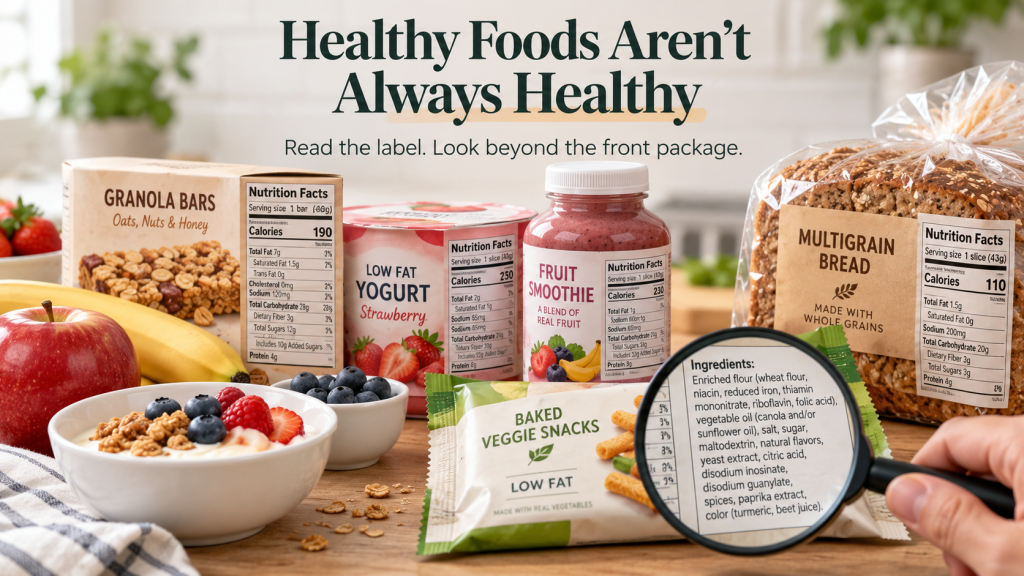
We see the word “healthy” everywhere.
Healthy cereal.
Healthy granola bars.
Healthy smoothies.
Healthy frozen meals.
But here is the problem:
“Healthy” is often a marketing word, not a nutritional guarantee.
A product can look healthy on the front of the package and still contain a surprising amount of sugar, sodium, refined oils, or highly processed ingredients.
That is why I always say:
Don’t judge food by the front label. Turn it around.
The real story is usually on the back.
1. Granola and Granola Bars
Granola has a healthy image because it contains oats, nuts, and seeds.
But many granolas also contain:
- Added sugar
- Syrups
- Refined oils
- Chocolate coatings
- Large serving sizes
A small portion can contain much more sugar than people expect.
2. Flavored Yogurt
Yogurt can be a great source of protein and calcium.
But flavored yogurt can sometimes contain as much added sugar as a dessert.
A better option is often plain yogurt with fresh fruit added at home.
3. Bottled Smoothies
Smoothies sound healthy because they contain fruit.
But some bottled smoothies are very high in sugar and low in fiber.
Drinking fruit is not always the same as eating whole fruit.
Whole fruit usually gives you more fiber and can help you feel full longer.
4. “Multigrain” Bread
Multigrain simply means that more than one type of grain was used.
It does not automatically mean the bread is whole grain.
Look for words such as:
100% Whole Wheat
or
100% Whole Grain
near the top of the ingredient list.
5. “Low-Fat” Foods
Low-fat products became popular because people assumed less fat always meant healthier.
But when manufacturers remove fat, they often add sugar, starch, or other ingredients to improve taste and texture.
Sometimes the regular version may actually have a simpler ingredient list.
6. Plant-Based Does Not Always Mean Healthy
Plant-based foods can be healthy, but the words “plant-based” do not automatically mean nutritious.
Some plant-based products are highly processed and contain:
- High sodium
- Refined oils
- Additives
- Artificial flavors
Again, the ingredient list matters.
Become a Food Detective
You do not need to be a nutrition expert.
Just start asking a few simple questions:
- How much added sugar is in this?
- How much sodium?
- What are the first five ingredients?
- Is this mostly whole food or highly processed ingredients?
- Is the serving size realistic?
Small questions can lead to better choices.
The goal is not perfection.
The goal is awareness.
Real food does not need a complicated marketing campaign.
The more we learn to read labels and understand ingredients, the easier it becomes to make better choices for ourselves and our families.
Be curious. Read the label. Stay informed.
— Real Food Detective


Leave a Reply