Walk through any grocery store and you’ll see packages covered with words like “natural,” “high protein,” “whole grain,” “low fat,” and “made with real ingredients.”
Those claims may sound reassuring, but they don’t always tell you how much a food has been processed.
If you really want to understand what you’re buying, turn the package around.
The ingredient list can often tell you much more than the marketing on the front.
Start With the First Three Ingredients
Ingredients are generally listed in order by weight. That means the first few ingredients usually make up the largest portion of the product.
For example, if the first three ingredients are:
Sugar, refined flour, and vegetable oil
the product is probably very different nutritionally from one that begins with:
Oats, almonds, and dates.
You don’t need to memorize every chemical name. Start by looking at what makes up most of the food.
10 Things Worth Paying Attention To
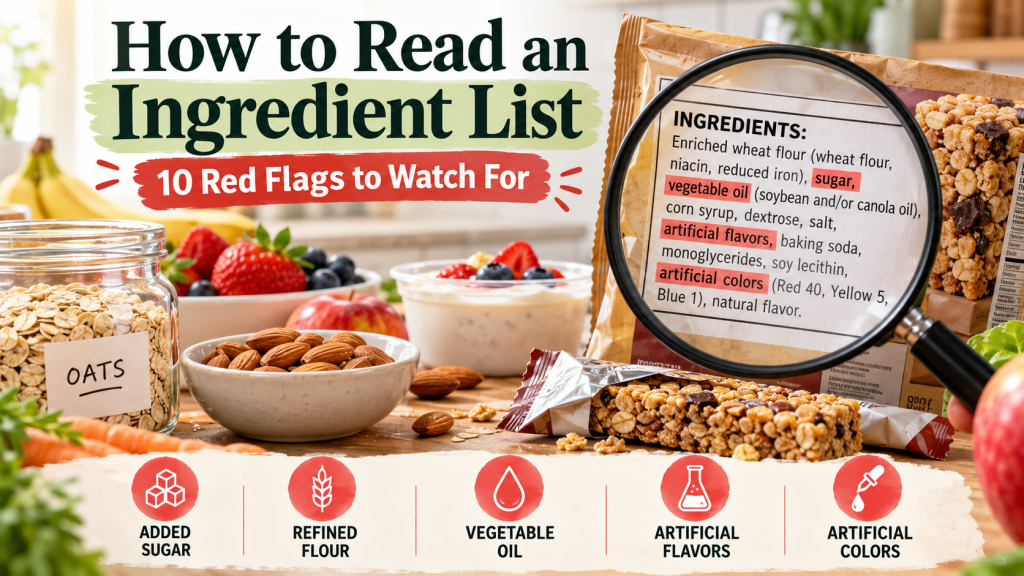
When reading ingredient labels, these are useful signs to notice:
- Several forms of added sugar
Sugar can appear under many names, including corn syrup, cane sugar, glucose, fructose, malt syrup, and dextrose. Using several types of sweeteners can make it harder to recognize how much sweetener is in a product. - Refined grains as the main ingredient
Products made primarily from refined flour generally contain less of the original grain structure than intact or minimally processed grains. - Long lists of flavorings
Phrases such as “natural flavors” or “artificial flavors” don’t automatically make a product unhealthy, but they can indicate that flavor has been added rather than coming primarily from the original food. - Artificial colors
Bright colors can make food more visually appealing even when the color has little to do with the food’s natural ingredients. - Multiple emulsifiers and stabilizers
Ingredients such as gums, emulsifiers, and stabilizers are often used to improve texture, consistency, or shelf life. - Hydrogenated or highly refined fats
Look closely at the types of fats and oils used, especially when they appear near the beginning of the ingredient list. - Very little recognizable food
If most ingredients sound like substances you would never use in a home kitchen, that can be a clue that the product has gone through significant industrial processing. - Sweeteners in foods you wouldn’t expect
Added sugars can appear in bread, sauces, salad dressings, flavored yogurt, cereal, and many other foods that aren’t traditionally considered desserts. - A health claim paired with a highly processed ingredient list
A package can advertise protein, vitamins, fiber, or whole grains while still containing large amounts of refined starches, sweeteners, oils, and additives. - An ingredient list much longer than expected
A long ingredient list does not automatically mean a food is unhealthy, but it is worth asking a simple question: Why does this food need so many ingredients?
But Don’t Judge a Food by Ingredient Count Alone
This is important.
A product with 15 ingredients is not automatically bad, and a product with only three ingredients is not automatically healthy.
A homemade soup, for example, could easily contain vegetables, beans, herbs, spices, broth, and other ingredients.
What matters more is what those ingredients actually are and how much the original food has been altered.
A Simple Grocery Store Test
Here’s a habit I like:
Before putting a packaged food into your cart, ask yourself three questions.
What are the first three ingredients?
Do I recognize most of the ingredients?
Is the product mostly made from food—or mostly made from refined ingredients and additives?
You don’t have to become a nutrition scientist.
You just have to become a better detective.
Real Food Usually Doesn’t Need a Sales Pitch
An apple doesn’t need to say “made with real fruit.”
Eggs don’t need a label saying “high protein.”
Broccoli doesn’t need brightly colored packaging promising antioxidants.
Real foods are often surprisingly simple.
That doesn’t mean we need to eliminate every packaged or processed food from our lives. Convenience matters, and food choices are rarely perfect.
The goal is simply to become more aware of what we’re eating.
Because when you understand the ingredient list, you stop relying entirely on the claims printed on the front of the package.
And that’s exactly what being a Real Food Detective is all about.


Leave a Reply