Walk into almost any grocery store today and you will see thousands of products competing for your attention.
Some packages say “natural.” Others say “high protein,” “low fat,” “whole grain,” or “made with real ingredients.”
But here is a simple question:
How much of what we eat today is actually real food?
At Real Food Detective, this is one of the questions we want to explore.
Not because every packaged food is bad.
Not because everyone needs to eat a perfect diet.
But because understanding what is in our food can help us make better choices.
What Is Real Food?
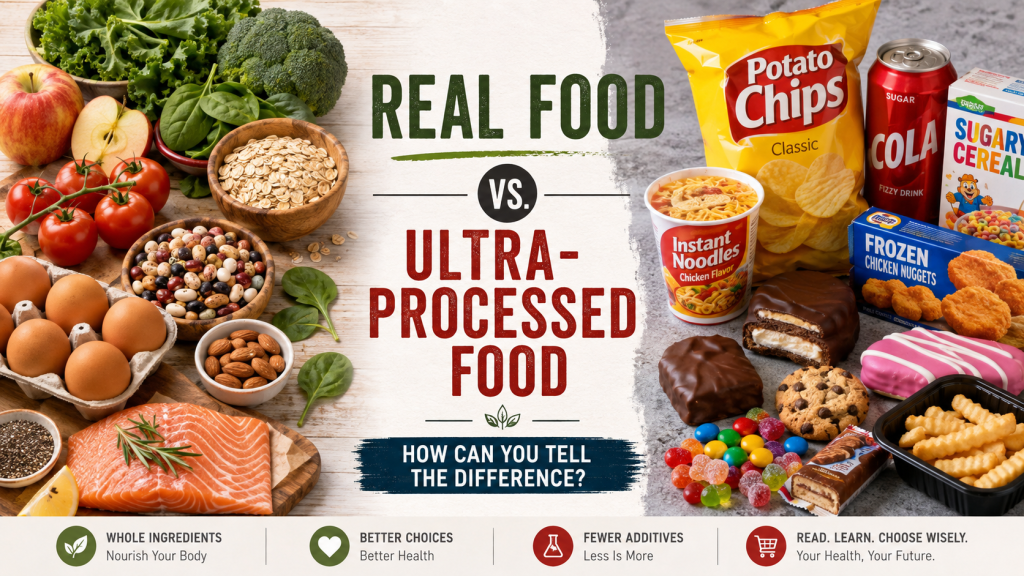
There is no single perfect definition of “real food,” but for this blog, I use the term to describe foods that are relatively close to their original form.
Think about:
- Apples
- Bananas
- Potatoes
- Eggs
- Fish
- Chicken
- Beef
- Beans
- Lentils
- Rice
- Nuts
- Vegetables
- Plain oatmeal
- Plain yogurt
These foods may be washed, cut, frozen, cooked, fermented, or packaged, but you can usually recognize what they came from.
A potato still looks like a potato.
An egg is still an egg.
Rice is still rice.
That sounds obvious, but compare those foods with some modern packaged products that may contain twenty or thirty ingredients.
That is where things become more complicated.
What Is Ultra-Processed Food?
Ultra-processed foods are generally industrial formulations made from food-derived substances along with ingredients that are uncommon in a home kitchen.
They may contain things such as flavorings, emulsifiers, sweeteners, modified starches, colorings, or other ingredients designed to change flavor, texture, appearance, or shelf life.
Common examples may include:
- Sugary breakfast cereals
- Soft drinks
- Candy
- Packaged snack cakes
- Many flavored chips
- Some frozen meals
- Some processed meat products
- Certain protein bars
- Many fast-food products
This does not mean that every food that comes in a package is automatically unhealthy.
That distinction is important.
Processed Does Not Automatically Mean Bad
Processing food is nothing new.
People have been cooking, drying, freezing, fermenting, grinding, and preserving food for thousands of years.
Kimchi is processed.
Cheese is processed.
Plain yogurt is processed.
Frozen vegetables are processed.
Canned beans are processed.
Tofu is processed.
But these foods are very different from an industrial snack product made primarily from refined ingredients, flavor enhancers, sweeteners, and additives.
So instead of asking:
“Is this food processed?”
A better question may be:
“How much has this food been changed from its original ingredients, and what was added along the way?”
Why Does Ultra-Processed Food Matter?
Researchers are increasingly studying the relationship between ultra-processed foods, calorie intake, weight gain, and health.
In a controlled National Institutes of Health study, participants eating an ultra-processed diet consumed more calories and gained weight compared with when those same participants ate a minimally processed diet, even though the meals offered were designed to have similar amounts of calories and major nutrients.
That does not mean one processed food will make someone overweight.
Body weight and health are influenced by many factors, including total diet, physical activity, sleep, genetics, medications, stress, income, food availability, and environment.
But the study raises an important question:
Could the way modern food is manufactured make it easier for us to eat more than we realize?
That is a subject we will explore often at Real Food Detective.
How Can You Tell the Difference?
You do not need to become a nutrition scientist.
Start by turning the package around.
1. Read the Ingredient List
Ask yourself:
Do I recognize most of these ingredients?
For example:
Peanut butter:
Peanuts, salt.
Compare that with a product containing multiple sweeteners, oils, flavorings, stabilizers, and other additives.
A longer ingredient list does not automatically mean a product is unhealthy, but it gives you useful information about how the food was made.
2. Look at Added Sugar
The Nutrition Facts label in the United States separately lists Added Sugars, making it easier to see how much sugar was added during manufacturing rather than occurring naturally in the food.
For example, there is an important difference between the natural sugar found in an apple and large amounts of sugar added to a soft drink.
3. Look at Serving Size
One package does not always equal one serving.
The FDA notes that serving size on a Nutrition Facts label reflects amounts people typically consume; it is not necessarily a recommendation for how much you should eat.
Always check:
How many servings are actually in this package?
4. Compare Similar Products
Do not judge a food only by the front of the package.
Turn two products around and compare them.
Look at:
- Ingredients
- Added sugar
- Fiber
- Protein
- Sodium
- Serving size
Sometimes two products that look almost identical on the front are very different on the back.
A Few Simple Comparisons
Apple vs. fruit-flavored candy
Both may taste sweet, but they are completely different foods.
Potato vs. flavored potato chips
The potato begins as a whole food. The final snack may contain added oils, flavorings, sodium, and other ingredients.
Plain oatmeal vs. sugary breakfast cereal
Both begin with grains, but the finished products can be very different depending on processing and added ingredients.
Plain yogurt vs. dessert-style flavored yogurt
The word “yogurt” on the package does not tell you the whole story. Look at the added sugar and ingredient list.
Food Is Also About Culture
This discussion becomes even more interesting when we compare cultures.
Traditional Korean food may include rice, vegetables, fermented foods, soups, fish, meat, tofu, and side dishes.
Traditional Mexican food may include corn, beans, tomatoes, peppers, avocado, meat, and fresh herbs.
Mediterranean and Spanish eating patterns may include vegetables, legumes, seafood, olive oil, grains, and fruit.
American food also includes plenty of real foods—but modern American eating is heavily influenced by convenience foods, restaurant meals, sugary drinks, and highly processed packaged products.
And today, ultra-processed food is not just an American issue.
It is spreading around the world.
Even traditional cuisines are changing.
That is why the question is not:
“Which country has good food and which country has bad food?”
The better question is:
“What happened to the food between the farm, the factory, the restaurant, and our plate?”
The Real Food Detective Rule
Here is a simple rule I plan to use throughout this blog:
Look beyond the front of the package.
Ask:
What is it made from?
How was it made?
How much has it been processed?
What has been added?
And is there a simpler alternative?
You do not have to eliminate every processed food from your life.
The goal is not perfection.
The goal is awareness.
Because when we understand our food, we can make better decisions about what we put on our plates.
And that is what Real Food Detective is all about.
Real Food Detective provides general educational information about food and nutrition. It is not intended to provide medical diagnosis, treatment, or individualized dietary advice.


Leave a Reply